Evidence based vs anecdotal

I’m increasingly disturbed by a very backward tendency to implement bad science in healthcare IT systems. More and more often, I read about initiatives to mine electronic healthcare records for data and build some kind of knowledgebase from this, then use it to support clinical decision making. It sure sounds sexy from a technical standpoint, but it’s so wrong.

We used to have anecdotal medicine, or experience-based medicine if you prefer, where each doctor largely learned from his own patients, mistakes, and successes. This led to a lot of wrong conclusions, since outcomes are multifactorial. That is, there are a bunch of reasons why any particular case goes right or goes wrong, and you can’t control for those reasons if you learn from cases after the fact.

Then we decided to only advance medical science on properly designed, prospective, and controlled clinical studies, which seems to be the only way to get anywhere in the long run. So that’s what we should do.

The reason I posted this today is that I just read something horrifying in an otherwise excellent book (which you can get for free here), the “4th Paradigm”, Microsoft Press. This is an excerpt:

…current trends toward universal electronic healthcare records mean that a large proportion of the global population will soon have records of their health available in a digital form. This will constitute in aggregate a dataset of a size and complexity rivaling those of neuroscience. Here we find parallel challenges and opportunities. Buchan, Winn, and Bishop apply novel machine learning techniques to this vast body of healthcare data to automate the selection of therapies that have the most desirable outcome. Technologies such as these will be needed if we are to realize the world of the “Healthcare Singularity,” in which the collective experience of human healthcare is used to inform clinical best practice at the speed of computation.

No, please don’t destroy medical science like this…
Need for push

A number of Swedish media sites are down right now, newspapers and stuff, due to a DDoS attack of some kind. Now, this is serious. News sites are at the core of a free and open society.

This got me thinking about how to solve DoS in general and there are ways. I’d suggest two mechanisms.

1. Move from a pull model to a push model for subscribed web content. Push can be done from any old place, so there’s nothing for the attackers do DoS. I’d imagine the client to have a front end or proxy that checks for the right digital signatures to allow content in. The bad guys can still DoS the clients, but with very little return on investment. Not so surprisingly, we don’t have the required technologies in place, but there’s an abundance of components already in existence for such a system, so it should be straightforward to assemble.

2. For those services that can’t be done with push, use a smarter client that is able to go look for services according to preset algorithms or using a form of dynamic DNS. IOW, move the load balancer to the client side instead of the server side. (I’ve done this, it works.) This won’t eliminate a DoS entirely, but will make it orders of magnitude more difficult.

The problem here is that there is no incentive for the large hosting players to do anything that diminishes the need for giant pipes and huge data centers. So we can’t count on them to help out.

Useless email limitation

Something just happened here in old Sweden. A doctor sent an email with confidential patient info to a local government office, but fatfingered the adresses, so it ended up with 200 different people at that government office. Problem was, except for the numbers, that the patient he was divulging info about, actually works at that office as well. Embarrassing, to put it mildly. Now they’re discussing what disciplinary measures to apply for fatfingering the destinations.

But the problem here isn’t that he fatfingered the adresses, the problem is that he used email at all. Except that seems to be established practice here. I don’t, btw. I stick to envelopes or encrypted fax.

I got an email account at the provincial healthcare system where I work, but I can’t get at that email account from the outside. I found that pretty dumb. After reading about this case, I changed my mind. Now I find it totally moronic. Allowing me to access it only from inside the provincial healthcare network gives me the impression that it is somehow a local and safe medium, which it is not. I’m perfectly able to send out any confidential information to absolutely anyone in the world, using this system, intentionally or otherwise. The only thing the access restriction actually prevents is… um… normal use?

To be fair, there is the hypothetical danger of someone hacking into my email account from the outside, to get at confidential information that someone else may have sent me and that I haven’t, for some reason, deleted, but compared to the danger of me actively sending out information by mistake to the wrong people, like a mailing list or a group adress, it’s negligible. No egress filtering is in place that I know of.

There is one useful solution to all this, namely a messaging feature in the electronic health care record system, since that automatically limits distribution to other authorized users of the system itself. But in our case, that function disappeared when they changed out our old system for a new and “improved” one.

In conclusion, I’ll claim that limiting outside access to the mail system like this is an illconsidered and useless move, more likely than not to be counterproductive.

What a strange piece

Can’t help commenting on this opinion piece on TechRepublic: The Apple Tablet will disrupt Apple’s device momentum. Just a few choice quotes:

… 1) providing good entertainment; and 2) providing flexible input and output. The success of the iPhone illustrates how correct I was in the first point. It stumbled into the entertainment angle.

Yes, sure, Apple “stumbled” into success.

In fact, every key innovation in PC technology for the past 30 years has been driven by gamers, but Microsoft, HP, and everyone else – including Apple with its largely accidental success with the iPhone – have ignored this in the portable electronic device market. And the whole time, I feel like I’ve been jumping up and down, screaming, “Deliver the games, become the dominant games delivery system – and the rest will follow!”

You didn’t scream loud enough, did you? Oh, btw, me and a lot of other people I know buy iPhones for other reasons than games, like for their business and connectivity apps, you know? Haven’t heard of those yet? Maybe if you stopped jumping up and down and screaming for a sec, you’d hear us talking about that.

“Take my word: The super-hyped Apple Tablet – which is supposed to be a convergence of the iPhone, the Apple Mac, and the netbook phenomenon – is going to be a failure”

What Apple Tablet? Nobody has seen one, but you already know what it’s going to be and even why it will ultimately fail.

Why will the Apple Tablet fail? The one thing consumers don’t want is another gadget that ultimately does the exact same thing as several other gadgets they already own, especially one that requires all kinds of contortions to move legally-licensed and legitimately-owned content around from device to device.

Yes, especially as Apple is known for making their users buy media again and again every time another product of theirs comes on the market. Like the last time people bought all their media on the Play-For-Sure system only to discover that it wouldn’t play on the new generation Apple Zune. We’re not going to walk into that trap again, are we? When will Apple finally learn to treat their customers with respect, like Microsoft does with their iTunes, which is not only DRM free but works across devices without new purchases being required.

Oh, wait, did I get that backwards?

Then I just skimmed through the rest, but if you feel like being abused by more of that bad thinking, please head over there and enjoy some more of these “insights”.

What’s up with Snow Leopard and file sizes?

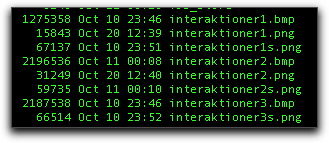
Yes, I know Snow Leopard changed the way they calculate file and volume sizes, but what I’m seeing here is too weird to be explained by that. I’ve got a few image files in a folder on my desktop and the filesizes I’m seeing with ls -al is:

583

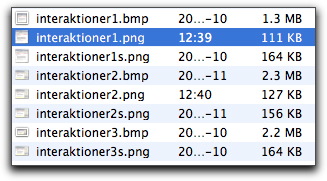
Now watch the png file sizes when I look at it using Finder:

584

Oops… WTF was that??! A display bug! Let’s try again after juggling the column widths so the selection bar straightens itself out again:

585

Just to be sure, I opened up the info panel on the first file:

586

Yes, truly, here it says 109,207 bytes while ls -al says 15,843 bytes for the same file. And yes, I’ve checked and double checked and triple checked, I do indeed look at the same file. Doing a spotlight search also only returns one image. Uploading the image to a webserver and checking through Transmit shows the 15k size. Here it is, the file, from a webserver: http://vard-it.com/images/20091019/interaktioner1.png, so you can check for yourself.

So why is Finder reporting a size value seven times larger?

Update a little later: yes, I used the ls -al@ to find the resource fork and that is what is making the difference. Maybe Finder should have the option of showing that separately at least in the inspector? Maybe I should read the man pages before posting? Maybe I should wonder what exactly are in those resources? Maybe I should just shut up and crawl under a rock?

Yet another update: I used 0xED to look into the file and the fork. The fork is full of Adobe info, since I used Photoshop CS4 to convert from a BMP to PNG. And, obviously, when uploading the image using Transmit, that fork is stripped off. Well, now I know that Photoshop saves a load of info in a resource fork, possibly including  info I don’t want them to save. Can’t see any obvious way of excluding that in the Photoshop save dialog box. So take care when passing on images to others that you strip off the resource fork first. Somehow.

Update about “Somehow”, this is how to do it: create an empty file, copy it over the resource fork, then delete the empty file. Like so, in terminal:

588

DoS your kids

Saw this “How old will you get?” site, in Swedish, linked from a friend’s Facebook page (or an ad, can’t really make it out, but that’s the nature of FB, right?):

6002253120099_1_65be9044

Stupid site, don’t go there. But if you do go there, they ask you to register. So you don’t, but click “Starta testet” instead. Then they ask you for your email address, so you invent a dummy address, of course. Then they ask you for your personal number (before you Americans freak out, it’s not as secret as a social security number, but still, I wouldn’t give it to them), so you invent one. You’ve got a one in ten chance of making it a valid number, since only one digit is used as a check digit.

Anyway, after three failed tries, you get this:

581

Great! Love it. Which inspired me to think we could use this mechanism to stop other members of our little NAT tribe, since we’re all behind the same public IP, to get to that stupid site so our kids could give away email adresses and personal numbers to dubious people. Instead of blacklisting their domains in the router, let’s lock out our public IP by random login trials.

Not that I see what advantage the method has technically, but it’s just so cool turning their own tools against them.

So much knowledge in such a small box

I was doing the rounds at a nursing home out in the sticks the other day, and came to an old (all of them were old) woman with a urinary catheter and bag. Her problem, or rather her worry, was that the bag turned violet from the urine sometimes, but only the last week. The urine itself didn’t change color, only the plastic of the bag.

I already knew that some laxatives can cause the urine itself to turn violet if it’s alkaline, and I’ve heard of this phenomenon of the plastic becoming discolored, but as far as I remembered, it wasn’t alarming, so I just made the regular soothing doctor noises. But the nurse persisted, said she’d heard it could indicate urinary tract infections.iphone

So I pulled out my iPhone, opened Safari, and googled “violet urine bag” and lo and behold, there’s an article about the “Violet urine bag syndrome” from Osaka University, explaining how this happens in some urinary tract infections. Other similar articles taught me which bacteria are usually involved and when to look out for it.

I happily explained this to the nurse and told her she was right and I was wrong. Then the patient said to the nurse: “Amazing how they can get so much knowledge into such a small package” and they both looked with wonder and amazement at my iPhone. I was on the verge of explaining it wasn’t in the phone but on the ‘net, but then I thought: what’s the difference, really? Isn’t that just a technical detail? So I just nodded and said “yes, indeed”.

Protected media truly stink

I’m so fed up with protected media of all kinds making me spend time doing shit that I shouldn’t have to do. This is what I encountered today for the hundredth time (less, but it feels so):

Zinio ReaderScreenSnapz002

Every time this happens, you have to uninstall Zinio, delete its prefs, clear up a cache somewhere, then reinstall and reauthenticate it. Yes, I’ve got the routine documented, but man, this isn’t right. So I wrote them this letter, with absolutely no hope of them giving a damn:

Guys,

Really, time for you to get a grip. I’ve had MacWorld on Zinio for a couple of years now, and I’m growing so sick and tired of this 22-M error you never seem to fix, that I’m almost prepared to give up on subscribing to MacWorld anymore. You really need to fix this pronto. Show that you care, for once.

Every time anything at all changes on my machine, I have to manually go uninstall all of Zinio and reinstall it again, just to make it stop accusing me of being a thief. I can’t count the number of times I’ve had to do this. I have it installed on two machines, a Pro and a MacBook, and if that is too much for you, well, it’s going to be goodbye at next renewal.

I’m copying MacWorld too, since I think they should be aware of why they’re losing this particular subscriber at least. I’d sincerely suggest they’ve got a better chance of keeping paying subscribers by distributing unprotected pdf’s, or at least pdf’s protected by somebody else than Zinio.

Sincerely,

— Martin

PS: I could have added “You’re worse than Microsoft”, but that would be overdoing it.

PPS: No, I haven’t read the MacWorld issue. I’ll try to find the energy to go through that crap later, so I can actually see it, but I can’t keep myself from wondering if it’s worth the trouble. Very bad sign.

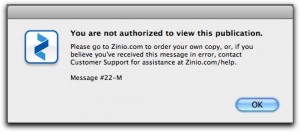
Update Oct 11: after reinstalling on my desktop Mac Pro and redownloading the last issue of MacWorld, I got this dialog box instead:

576

I mean, seriously, reading a mag is supposed to be relaxing, but this??!

Update Oct 16: Got another message from Zinio support telling me to do the exact same thing their previous message told me to do. That is, download the uninstaller, uninstall, download the installer, install, authenticate, hope for best, try. Since they sent that message twice, I figured I could repeat the procedure just for kicks, and sure enough, this time it worked. Um, no, actually not. I discovered that the issue file I redownloaded from Zinio according to the instructions I got the last time was corrupt, with a bad filename and extension. In other words, when Zinio told me “you do not have rights to this publication on this computer” it actually meant “this file is corrupt”. Would you have guessed? So I copied the file I had on my MacBook to the Mac Pro, and then it worked. Except it took another hour or so until I could read the MacWorld issue due to this problem:

580

In other words, if the Zinio server is down anytime the reader wants to verify your status, which is the first time you open it and whenever it feels unsure of itself, you’re out of luck yet again.

Right, now I can finally read the November issue of MacWorld on my portable and my desktop. Am I happy? Not really. As I already said, reading a mag is supposed to be relaxing. I’m prepared to pay for convenience. But all I’m getting for my money is aggravation. I’m not going to extend my subscription anymore, hoping instead that the so far mythical Apple iTablet will revolutionize this market and bring something much more useful and pleasant. But if it doesn’t, I fear the end is near for DRM’ed online publications.